

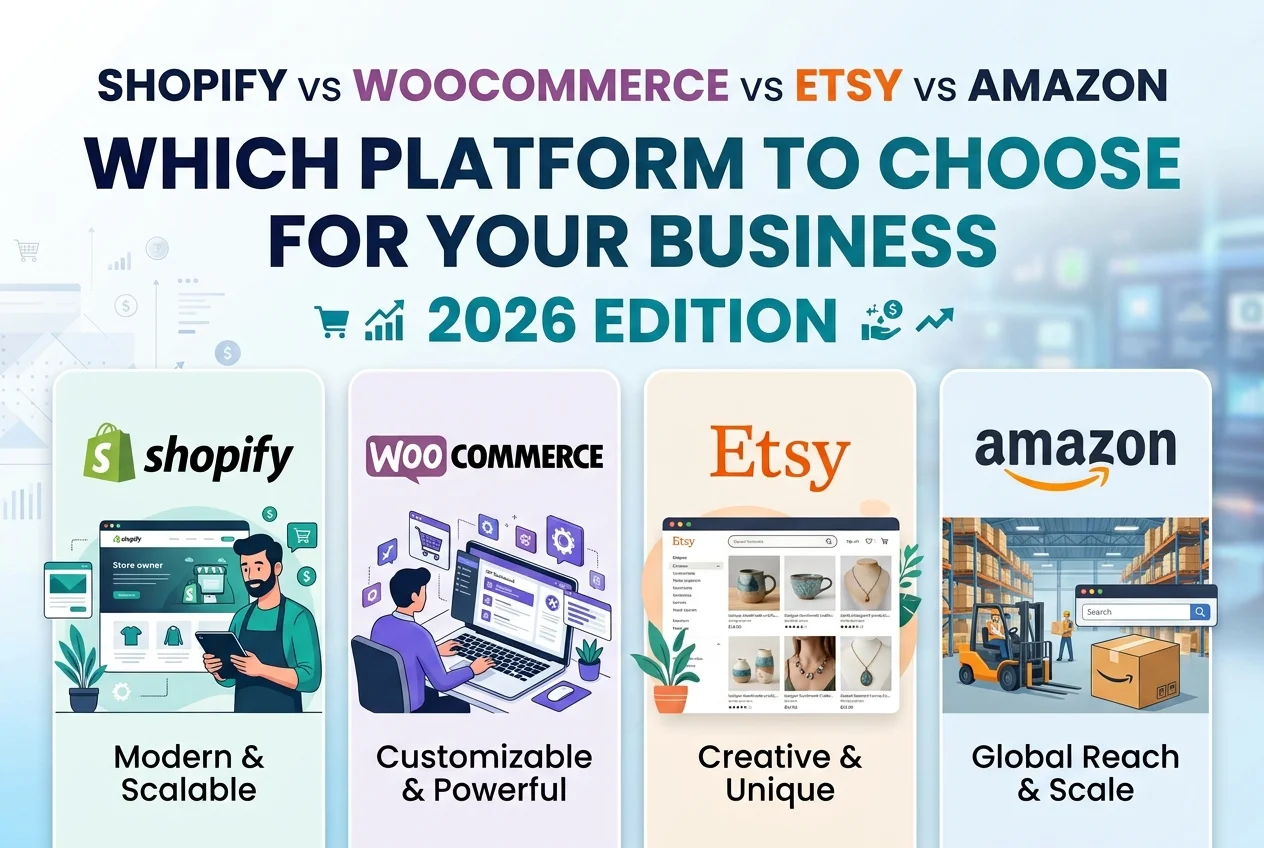
Shopify vs WooCommerce vs Etsy vs Amazon: Which Platform to Choose for Your Business 2026
The platform you choose determines everything: how much you pay, how much control you have, how fast you can launch, who finds your products, and ultimately how much profit you keep. The four dominant options — Shopify, WooCommerce, Etsy, and Amazon — each excel in different scenarios. One is the easiest all-in-one solution. One gives you total ownership. One brings built-in buyers for creative goods. One puts you in front of the largest shopping audience on earth.
This guide compares all four platforms across every important factor. By the end, you will know exactly which platform matches your business model, technical comfort, budget, and growth goals.
Quick Overview Table
| Factor | Shopify | WooCommerce | Etsy | Amazon |
|---|---|---|---|---|
| Type | Hosted all-in-one | Self-hosted WordPress plugin | Creative marketplace | Massive product marketplace |
| Base Cost | $39/month Basic | Free plugin + hosting $5–$100+/month | $0.20 per listing + fees | $39.99/month Pro or Individual |
| Setup Time | Hours to days | Days to weeks | Hours | Days to weeks (approval) |
| Technical Skill | Low — drag and drop | Medium to high | Very low | Low to medium |
| Design Control | Good — themes and code | Full — 100% customizable | Limited — marketplace template | Very limited — strict format |
| Built-in Traffic | None — you drive all traffic | None — you drive all traffic | Strong — Etsy search and marketing | Massive — 300M+ monthly shoppers |
| Branding | Strong — your own domain and store | Maximum — fully your brand | Weak — Etsy brand dominates | Very weak — Amazon brand dominates |
| Ownership | You own products and customer data | You own everything completely | Etsy owns the platform relationship | Amazon owns the customer relationship |
| Best For | Most businesses, beginners to scaling | Technical users, full control needed | Handmade, vintage, creative goods | Existing products, high volume, price competition |
Platform 1: Shopify — The All-In-One Standard
Shopify is the most popular ecommerce platform in the United States and the world. It is a fully hosted solution — meaning Shopify owns and maintains the servers, security, payment infrastructure, and platform updates. You build your store on top of their system using drag-and-drop tools.
Pricing 2026:
- Basic: $39/month — 2 staff accounts, up to 4 locations, basic reports
- Shopify: $105/month — 5 staff, up to 5 locations, professional reports, lower payment fees
- Advanced: $399/month — 15 staff, up to 8 locations, advanced reports, lowest payment fees, international pricing
- Payment fees: 2.9% + $0.30 per transaction (Basic), 2.6% + $0.30 (Shopify), 2.4% + $0.30 (Advanced) when using Shopify Payments
- Credit card rates if using external gateway: Additional 2% (Basic), 1% (Shopify), 0.5% (Advanced)
- Starter/Social: Lower-cost options exist for social selling only
Strengths:
- Fastest setup — store can launch in hours using pre-built themes
- No technical maintenance — Shopify handles security, updates, uptime, PCI compliance
- App ecosystem — 8,000+ apps add any functionality: reviews, subscriptions, bundles, loyalty, print on demand, dropshipping
- Beautiful themes — professional designs, many free, most mobile-responsive
- Multi-channel selling — sell on website, Facebook, Instagram, TikTok, eBay, Walmart, and in-person POS from one dashboard
- Shopify Magic AI — built-in AI for writing product descriptions, emails, and theme customization
- Shopify Payments — integrated payment processing, no separate merchant account needed
- Scales smoothly — from first sale to enterprise volume without switching platforms
Weaknesses:
- Monthly cost adds up — especially when apps are added on top
- Less than 100% control — you cannot modify core platform functionality
- Customization beyond theme options requires Liquid coding knowledge
- Transaction fees if you choose not to use Shopify Payments
- You do not own the platform — if Shopify changes rules or raises prices, you must adapt or migrate
Platform 2: WooCommerce — Full Control and Ownership
WooCommerce is a free open-source plugin that turns any WordPress website into an ecommerce store. Because it is self-hosted, you need your own hosting, domain, SSL certificate, and you are responsible for maintenance, security, and updates. In exchange, you get complete ownership and unlimited customization.
Real Total Cost 2026:
- WooCommerce plugin: Free
- WordPress: Free
- Hosting: $5–$30/month entry, $30–$150/month managed WooCommerce, $150+/month enterprise
- Domain name: $10–$20/year
- SSL certificate: Free via Let's Encrypt on most hosts, or paid extended validation $50–$200/year
- Premium theme: $0–$70 one-time or subscription
- Premium plugins: $0–$300/year total depending on needs (subscriptions, bookings, advanced shipping, etc.)
- Payment processing: Stripe 2.9% + $0.30, PayPal similar, no extra platform fee
- Developer costs (if needed): $500–$5,000+ for custom work
Strengths:
- 100% ownership — you control every file, every feature, every pixel. No one can shut you down or change rules.
- Unlimited customization — modify anything. Perfect for unique business models that standard platforms cannot handle.
- WordPress ecosystem — access to 60,000+ plugins and thousands of themes. Anything you can imagine has a solution.
- Content marketing built-in — WordPress was built for blogging. SEO and content strategy are native strengths.
- No transaction fees beyond payment processor — keep more revenue per sale.
- Scales from tiny to massive — enterprise brands use WooCommerce with custom hosting.
- WooCommerce 11.0+ improvements — variable product pages 9–12% faster, bundle products 6–12% faster at checkout.
Weaknesses:
- Steeper learning curve — you must learn WordPress, hosting, maintenance, security.
- You handle everything — updates, backups, security, PCI compliance, troubleshooting.
- Hidden costs — premium plugins, themes, and potentially developer time add up.
- Speed optimization requires work — WooCommerce is powerful but not fast out of the box on cheap hosting.
- Responsibility for downtime — if your site breaks, you fix it or pay someone to fix it.
Platform 3: Etsy — Built-in Audience for Creative Goods
Etsy is a marketplace focused on handmade items, vintage goods, craft supplies, and personalized products. Unlike Shopify or WooCommerce where you build your own storefront and drive your own traffic, Etsy puts your listings alongside millions of others in front of shoppers who are already searching and buying on the platform.
Fees 2026:
- Listing fee: $0.20 per item. Each listing lasts 4 months or until sold, then renews at another $0.20.
- Transaction fee: 6.5% of the total order amount including product price, shipping, and gift wrapping.
- Payment processing: 3% + $0.25 per transaction for US sellers.
- Offsite Ads fee: 12%–15% on sales generated by Etsy's external advertising. Mandatory for sellers making over $10,000/year.
- Currency conversion fee: 2.5% if you sell in a currency different from your payment account.
- Effective total: Typically 12–20% of each sale goes to Etsy depending on your ad settings and volume.
Strengths:
- Built-in buyer traffic — millions of shoppers actively searching Etsy every day. You do not need to be an SEO or ads expert to get initial sales.
- Extremely fast setup — create account, list products, start selling. No hosting, no domain, no technical work.
- Low financial risk — no monthly subscription. Pay only when you list and when you sell.
- Trust factor — Etsy brand is well-known and trusted for unique, handmade, and personalized items.
- Built-in marketing tools — Etsy Ads, sales and coupons, shop updates, community features.
- Print on Demand friendly — Etsy fully supports POD business models when properly disclosed.
Weaknesses:
- High fees — 12–20% of every sale significantly reduces profit margins compared to your own store.
- Limited branding — your shop page exists within Etsy's template. You cannot fully customize design or checkout flow.
- No customer ownership — Etsy owns the customer relationship. You cannot easily export email addresses or build independent marketing lists.
- Platform risk — Etsy can change fees, algorithms, or policies at any time. Your business is dependent on their goodwill.
- Competition within Etsy — thousands of sellers often offer similar products. Standing out requires strong SEO and reviews.
- Restricted categories — Etsy expects handmade, vintage, or craft supplies. Mass-produced generic products get removed.
Platform 4: Amazon — Largest Shopping Audience on Earth
Amazon is the dominant marketplace in the United States and many other countries. Listing on Amazon puts your products in front of over 300 million active customer accounts, including more than 200 million Prime members who shop with high frequency and trust.
Fees and Costs 2026:
- Individual plan: $0.99 per item sold. No monthly fee. Best for fewer than 40 sales/month.
- Professional plan: $39.99/month. No per-item fee. Required for many categories and advanced tools.
- Referral fee: 8%–15% depending on product category. Apparel typically 17%, most other categories 15% or lower.
- FBA fees (if using Fulfillment by Amazon): Storage fees + fulfillment fees per unit based on size and weight. Typically $3–$8+ per item.
- Merchant Fulfilled: You handle shipping. No FBA fees but you lose Prime badge and conversion advantage.
- Advertising (optional but common): Sponsored Products, Sponsored Brands, Sponsored Display. Most sellers spend 10–30% of revenue on ads.
Strengths:
- Massive built-in traffic — hundreds of millions of shoppers. No other platform gives you this level of immediate exposure.
- Prime advantage — Prime members convert at much higher rates and expect fast free shipping.
- Customer trust — Amazon is the most trusted shopping brand in the US. Shoppers buy confidently.
- Fulfillment by Amazon (FBA) — you send inventory to Amazon warehouses; they handle storage, picking, packing, shipping, customer service, and returns.
- Print on Demand compatible — Amazon Merch on Demand (native POD program) or Seller Central with third-party POD integration.
- International expansion — sell across multiple Amazon marketplaces worldwide.
Weaknesses:
- Extreme competition — thousands of sellers often compete on identical or nearly identical products. Price wars are common.
- Very limited branding — Amazon controls the product page format, checkout experience, and customer relationship.
- Strict rules and enforcement — Amazon suspends accounts first and asks questions later. One policy violation can shut down your business.
- You do not own customers — Amazon actively discourages seller-to-customer communication outside their platform. Building email lists is difficult.
- Approval required for many categories — gated categories need application and documentation.
- Complex fee structure — calculating true profitability requires careful accounting of referral fees, FBA fees, storage fees, return costs, and advertising.
Side-by-Side Comparison Across Key Decisions
1. Cost Comparison
| Scenario | Shopify | WooCommerce | Etsy | Amazon |
|---|---|---|---|---|
| Startup cost | Low ($39/month) | Low to medium | Very low ($0.20 per listing) | Low ($39.99/month) |
| At $5,000/month revenue | $39 + ~$160 payment fees + apps | Hosting ~$30 + payment ~$160 | Fees ~$700–$1,000 | Fees ~$600–$900 + ads |
| At $50,000/month revenue | $105 + ~$1,400 payment + apps | Hosting ~$100 + payment ~$1,400 | Fees ~$7,000–$10,000 | Fees ~$6,000–$9,000 + ads |
Key insight: Shopify and WooCommerce become dramatically more profitable than Etsy or Amazon as revenue grows. The marketplace platforms take a percentage of every sale forever.
2. Ease of Use
- Easiest: Etsy — list and sell, no technical decisions
- Very easy: Shopify — drag and drop, guided setup, no maintenance
- Moderate: Amazon Professional — listing rules and compliance requirements take learning
- Most work: WooCommerce — hosting, domain, SSL, maintenance, security all your responsibility
3. Control and Ownership
- Maximum control: WooCommerce — you own everything, modify anything
- Strong control: Shopify — your domain, your brand, your customer data, but platform is hosted
- Limited control: Etsy — you control products and shop policies but exist within Etsy's system
- Minimum control: Amazon — strict listing formats, Amazon owns customer relationship, rules change frequently
4. Traffic and Customer Acquisition
- Most built-in traffic: Amazon — massive audience already shopping
- Strong built-in traffic: Etsy — active marketplace with search and discovery
- Zero built-in traffic: Shopify and WooCommerce — you must drive every visitor through SEO, ads, social, content, or email
Which Platform Should You Choose? Decision Framework
| Your Situation | Best Platform | Why |
|---|---|---|
| New seller, limited technical skill, want to launch fast | Shopify | All-in-one, easy setup, no maintenance, professional results |
| Handmade, vintage, personalized, or creative goods | Etsy | Built-in audience actively looking for exactly these products |
| Technical comfort or developer access, want full control | WooCommerce | 100% ownership, unlimited customization, WordPress SEO power |
| Existing manufactured products, want maximum reach | Amazon | Largest shopping audience, FBA logistics, Prime conversion |
| Print on Demand business | Shopify (primary) + Etsy/Amazon (additional) | Shopify gives brand ownership; marketplaces add extra sales channels |
| Content marketing and SEO are core strategy | WooCommerce or Shopify with blog | Both handle content well; WooCommerce has slight edge due to WordPress roots |
| High volume, established brand, custom business needs | WooCommerce or Shopify Plus | Both scale; WooCommerce offers deeper customization, Shopify Plus offers enterprise support |
| Budget extremely tight, want to test products first | Etsy | No monthly cost, pay only when you list and sell |
The Multi-Platform Strategy — Best of All Worlds
Most successful ecommerce businesses eventually use more than one platform. A common and effective approach:
- Primary store on Shopify or WooCommerce: This is your brand home. You own the domain, the customer data, the email list, and the full profit margin. This is where you build long-term value.
- Etsy as discovery channel: List products on Etsy to reach shoppers who would never find your independent store. Use Etsy to acquire customers, then encourage them to buy directly from your website next time for better pricing or loyalty rewards.
- Amazon for volume: If your products fit Amazon's model, list there to capture high-intent shoppers. Treat Amazon as a sales channel, not your brand home.
- Social commerce: Connect your Shopify or WooCommerce store to Facebook, Instagram, TikTok, and Pinterest for additional sales touchpoints.
This multi-platform approach gives you the ownership and profit of your own store plus the traffic and reach of marketplaces. No single point of failure — if one platform changes rules or raises fees, your business continues on the others.
Summary
- Shopify = Best all-around choice for most businesses. Easy, fast, scalable, professional. You own your brand and customers. Monthly cost + payment fees.
- WooCommerce = Maximum control and ownership. Free plugin, but you pay with time, technical work, and hosting costs. Best for technical users or those needing custom functionality.
- Etsy = Fastest way to start selling creative goods with built-in traffic. But high fees (12–20%) and limited branding. Excellent as a discovery channel alongside your own store.
- Amazon = Largest shopping audience on earth. Perfect for existing manufactured products and high volume. But intense competition, strict rules, and you do not own customers.
- Cost grows differently. Shopify and WooCommerce have relatively fixed costs; Etsy and Amazon take a percentage of every sale. At higher revenue, your own store is dramatically more profitable.
- Consider multi-platform. Own store as foundation, marketplaces as additional channels. This gives you the highest revenue, lowest risk, and strongest brand long-term.
There is no universally "best" platform — only the best platform for your specific business stage, goals, and technical comfort. Choose based on where you are now, but build toward owning your customer relationship and your brand. That is the asset that grows in value over time.