

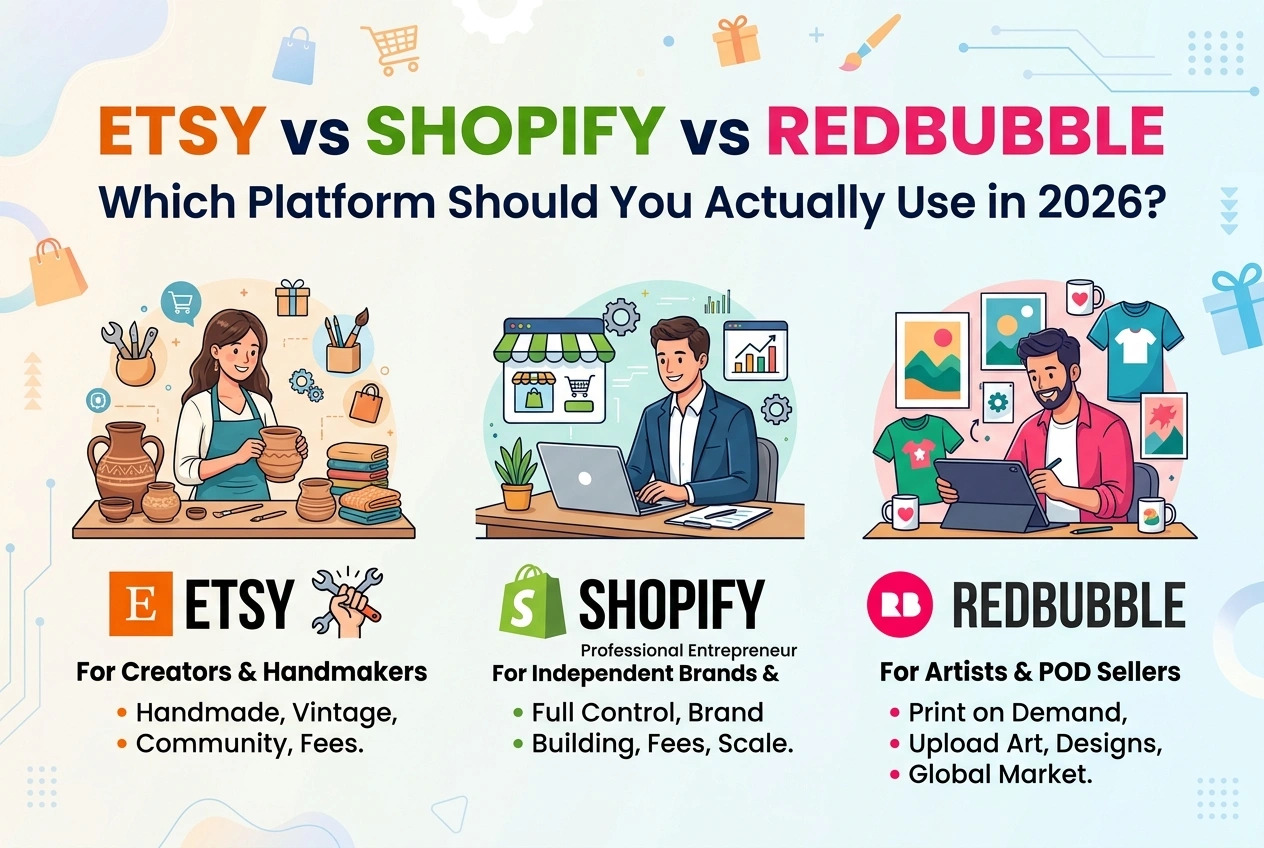
Etsy vs Shopify vs Redbubble: Which Platform Should You Actually Use in 2026?
Every Print on Demand seller faces the same decision: where should I list my designs? Three major platforms dominate the space, but they operate in completely different ways. One gives you instant traffic but takes high fees. One gives you total control but zero visitors. One requires almost zero work but pays pennies.
None is universally best. Each serves a different purpose at a different stage of your business. This guide compares all three head-to-head — fees, traffic, ownership, effort, and growth potential — so you choose wisely.
Quick Comparison Overview
| Etsy | Shopify | Redbubble | |
|---|---|---|---|
| Platform Type | Marketplace | Your own store | Global marketplace |
| Monthly Cost | $0 — pay per sale | $39/month (Basic) | Free forever |
| Total Fees Per Sale | ~9.5% – 12% | ~3% – 4% | 30% – 40% |
| Built-In Traffic | Millions of buyers | None — you build it | Global traffic |
| Customer Ownership | Etsy owns them | You own them | Redbubble owns them |
| Your Effort | List + SEO | List + SEO + Marketing | Upload and wait |
| Profit Potential | Medium-High | Unlimited | Low |
| Best For | Launching & validating | Branding & scaling | Passive income & testing |
Etsy: The Fastest Path to First Sale
How It Works
Etsy is a dedicated marketplace for handmade, custom, and unique goods. Millions of people visit Etsy specifically looking for exactly what you sell. You create a shop, list your designs with titles and tags, and Etsy puts your products in front of interested shoppers based on search relevance.
Costs and Fees
- Listing fee: $0.20 per item, renews every 4 months
- Transaction fee: 6.5% of total sale including shipping
- Payment processing: ~3% + $0.25 per transaction
- Optional offsite ads: 12–15% extra on sales from external ads
- Real total cost: Approximately 9.5–12% of every sale
Strengths
- Ready-made audience of buyers actively searching for unique items
- Zero monthly cost — risk-free to start
- Built-in tools, payments, shipping labels, and customer support
- Search algorithm favors new and relevant listings — great for beginners
- Integrates seamlessly with every major POD supplier
Weaknesses
- High percentage fees that grow expensive at scale
- You do not own your customers — no direct email access
- Limited design and branding control — your store looks like every other store
- Etsy can show cheaper competitors on your product page
- Algorithm changes can vanish your traffic overnight
Honest Verdict
Etsy is the single best place to launch. You can validate designs, learn what sells, and earn your first income without risking money or building a website. But Etsy is a rental, not a business you own. As your sales grow, those percentage fees become thousands of dollars lost annually.
Shopify: Your Store, Your Brand, Your Business
How It Works
Shopify is not a marketplace. It is a platform that lets you build your own independent website. Nobody visits Shopify.com to find you — they visit YOURDOMAIN.COM. You bring the traffic, you own the relationship, you keep the profit.
Costs and Fees
- Basic plan: $39/month (often available at discounted trial rates)
- Transaction fees: 2.9% + $0.30 per sale (can be reduced to 0% with Shopify Payments)
- Domain: ~$15/year
- Apps: Free and premium options available
- Real total cost: ~3–4% per sale + fixed monthly fee
Strengths
- Almost zero percentage fees — savings become massive at scale
- Complete ownership — customers, emails, data, relationship all belong to you
- Unlimited customization — your store looks exactly how you want
- Build a real brand — customers buy from YOU, not a marketplace
- Unlimited growth potential — no arbitrary limits or bans
- Integrates with every POD supplier and marketing tool
Weaknesses
- Zero traffic on Day One — you must build every visitor yourself
- Monthly cost regardless of sales — expense before income
- Steeper learning curve — you manage settings, payments, shipping, SEO
- Requires marketing skills — Pinterest, SEO, content, or ads
Honest Verdict
Shopify is where you build a real business asset. Once you prove designs sell on Etsy, moving them to Shopify doubles your profit margin and lets you own your audience. Shopify is not where beginners start — it is where serious sellers graduate to.
Redbubble: Zero-Risk Passive Income
How It Works
Redbubble is a global marketplace that handles EVERYTHING. You upload your design, set your profit margin, and leave. Redbubble prints, ships, handles customer service, processes returns, and manages the website. You do not choose suppliers, you do not handle orders, you barely manage anything.
Costs and Fees
- Platform: Free forever — no monthly fees
- Your profit: You set a markup percentage on top of Redbubble's base price
- Redbubble keeps the rest — typically 30–40% of the final sale price
- Example: A $30 t-shirt might pay you $3–$5 profit
Strengths
- Absolutely zero risk — costs nothing, manages everything
- Massive built-in global traffic
- Automatically places your design on 100+ product types
- Works while you sleep — truly passive income
- Great for testing hundreds of designs quickly
Weaknesses
- Terrible profit margins — you earn pennies per sale
- Zero control over pricing, products, or customer experience
- Your designs compete with millions of others on price alone
- Redbubble owns everything — customers, data, relationship
- Search and discovery are difficult — hard to rank for specific niches
Honest Verdict
Redbubble is the ultimate test platform. Upload every design you create and forget it. If anything sells, you learned something with zero effort. But do not build your business on Redbubble. The margins are too thin and the platform owns your audience.
Real Profit Comparison Example
Same t-shirt sold at $30 price point. Here is exactly what you keep:
| Platform | Price | Fees | Product Cost | Net Profit |
|---|---|---|---|---|
| Redbubble | $30.00 | ~$10.50 | Redbubble pays | $3.00 – $5.00 |
| Etsy | $30.00 | ~$3.00 | $15.00 | $12.00 |
| Shopify | $30.00 | ~$0.90 | $15.00 | $14.10 |
Shopify earns you nearly TRIPLE what Redbubble earns on the exact same sale. Etsy earns you nearly DOUBLE. That difference compounds dramatically as you scale.
Honest Recommendation: The Winning Strategy
Start on Etsy If:
- You want to earn your first sale as fast as possible
- You have no website experience and no marketing budget
- You want to test designs and validate demand risk-free
- You prefer spending time on designs, not technical setup
Add Redbubble If:
- You want passive income from every design you create
- You want to test hundreds of designs without managing listings
- You want global exposure without extra work
- You treat it as bonus income, not primary business
Move to Shopify Once:
- Your Etsy sales reach ~$2,000–$3,000 monthly consistently
- You know exactly which designs sell best
- Etsy's percentage fees are costing you hundreds monthly
- You are ready to own your customers and build your brand
- You plan to grow through SEO, content, and email marketing
Start Directly on Shopify If:
- You already understand SEO or content marketing
- You want to avoid marketplace fees from Day One
- Branding and ownership matter more than fast sales
- You have a clear niche and long-term plan
Can You Run All Three?
Absolutely — and this is actually the smartest strategy. Upload every design to Redbubble for passive income. List your best-performing designs on Etsy with proper titles, tags, and photos. Once you identify your winners and best niches, move them to Shopify where margins double and customers belong to you.
Redbubble tests everything. Etsy validates the winners. Shopify scales the business. Three platforms working together — not against each other.
Summary
- Redbubble = zero effort, zero risk, zero control, very low profit. Best for testing and passive bonus income.
- Etsy = built-in buyers, fast launch, reasonable fees, borrowed customers. Best place to start and earn real income.
- Shopify = highest profit, full ownership, unlimited growth, but you build the traffic. Best place to build a real business asset.
Start on Etsy. Upload everything to Redbubble in the background. Move your winners to Shopify. That is the proven path from zero to full-time income.